Wednesday, May 16, 2018

Severe weather season in Montreal - watch vs warning

Severe thunderstorms result in millions of dollars in damages every year across Canada. The threats are many with summer thunderstorms, including flash floods, strong winds, large hail, lightning and tornadoes.
Temperatures are slowly warming up across southern Quebec, and it won't be long before thunderstorms begin rattling around. With the increase in heat and humidity, will come the inevitable thunderstorm. Southern Quebec averages 15 to 17 thunderstorm days every year, most occurring between late May and early September. Severe thunderstorms are particularly menacing, because they come with several different high impact threats that can occur in any one region. They form very quickly, in lines or even as single cells. Tornadoes and lightning are among the greatest dangers within a thunderstorm. Lighting kills an average of 10 Canadians each year, while injuring 150 more. That being said, it is flash flooding, hail and strong winds that cause the greatest damage in Montreal.

Here are just a few examples of strong storms in Montreal. On August 22, 2017, a severe thunderstorm and microburst in the Borough of NDG, levelled thousands of trees and snapped hydro poles like twigs. On May 29, 1986, and again one year later on the same date, strong thunderstorms produced copious amounts of large hail, up to 12mm in diametre. The result was over $75 million dollars in damages to homes and cars across metro Montreal, and millions more in crop losses in southern Quebec. Of course the most famous thunderstorm in Montreal, occurred on July 14, 1987, when over 100mm of rain in less than 2 hours, flooded large portions of the city, including the Decarie Expressway. Known as the Decarie Flood, the storm resulted in two fatalities and $200 million in damages.

WATCH vs WARNING
The best way to protect yourself and property from summer storms is through awareness and vigilance. During hot and humid weather, listen for updated watches and warnings. Environment Canada will post a Severe Thunderstorm Watch, typically for a large area and a wide time frame. They are posted when conditions are favourable for severe thunderstorm development, but none are occurring yet. The watch is simply to advise the public that a threat does exist for severe weather. A Severe Thunderstorm Warning is an immediate call to action for a smaller portion of the watch area. The watch means strong storms have developed and are being tracked by Environment Canada. These storms are expected to impact the warned region. Keep in mind that thunderstorms form and dissipate very quickly. They are micro scale weather events, impacting a small geographical region at any given time. Therefore it is important that you check the time and source of the warning. Often social media will share information that is dated. Warnings are typically in effect for short periods of time for any given region, often less than one hour. They are updated often as the storms move through the area. The best course of action during severe thunderstorms, is to move inside, away from windows and doors. If outside, find the lowest point, make yourself as small as possible to avoid being struck by lightning.  More lightning safety tips can be found here.

Environment Canada continues to upgrade the doppler radar network across Canada, which will greatly improve severe weather forecasts as well as watch and warning times. You can read more on the new radar technology here.

Thursday, May 10, 2018

Flood risk on the decline - fire risk on the rise in Quebec

The warmer weather this week has allowed many of the tulips in Montreal to bloom. However a frost advisory is in effect Thursday night across the Eastern Townships, where lows could dip below freezing. 
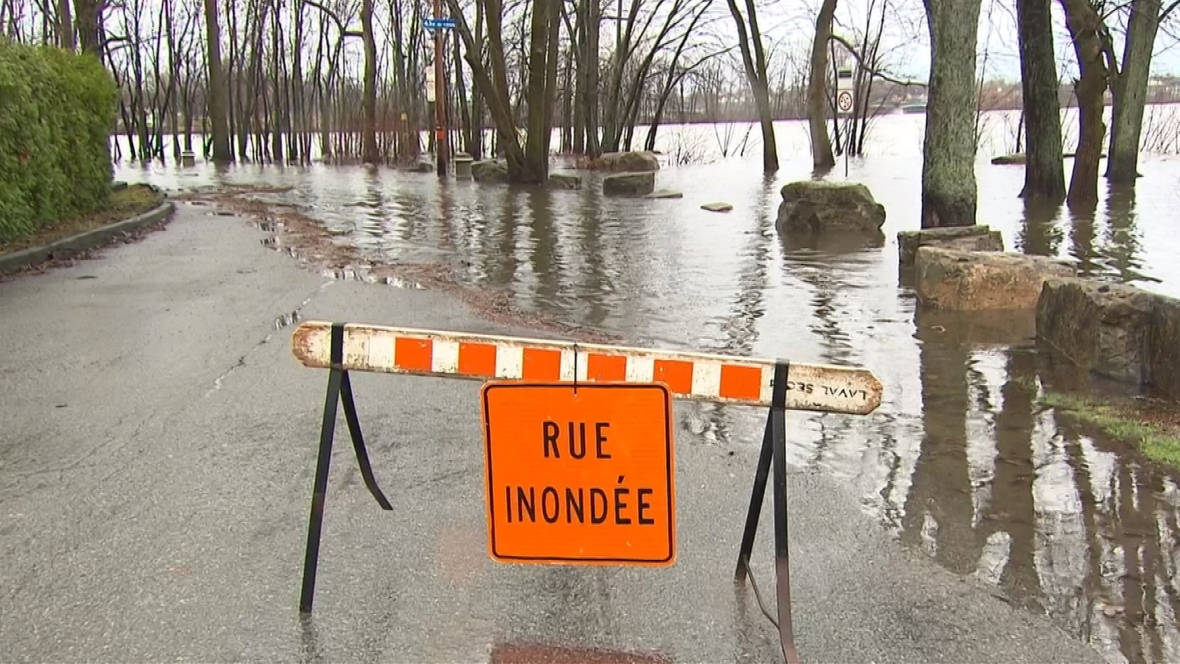
The spring flood risk has somewhat stabilized across southern Quebec. Dry conditions over the past week have allowed the rivers around Montreal to level off. The story is much the same in the Ottawa Valley. South of Montreal, Lake Champlain remains at flood stage, with the high water levels expected to travel north into the Richelieu Valley. According to Hydro Meteo, a flood warning is now in effect for the Richelieu River. At this time however, only minor flooding is forecast. Since May 1st, only 18.6mm of rain had fallen in and around Montreal. On Thursday, a few showers were forecast, but this will have little impact on water levels. The average rainfall for Montreal in May is 81.2mm. By comparison, during the historic Quebec floods of 2017, 160mm fell in April and 124mm in May.

A large portion of southern Quebec is in the elevated fire risk zone (yellow and orange). Any outdoor burning should be done with extreme vigilance. (SOPFEU)
Reconsider outdoor burning
Expect a very dry airmass to arrive behind the cold front Thursday evening. Temperatures will fall back below normal, along with low relative humidity values. According to SOPFEU, the forest fire watchdog in Quebec, the forest and brush fire risk is elevated for metro Montreal and the Monteregie, and very high for the Townships and Quebec City. Any outdoor burning should be done with extreme care. At this time, two fires are burning in the province, comprising 25.6 hectares (63 acres).

Looking ahead to the upcoming weekend and early next week, little if any precipitation is expected for Montreal. The dry breezy weather will only add to the fire risk. Colder temperatures will arrive Thursday night, with lows forecast close to the freezing point in several locations. Some frost is likely north of Montreal and across the Eastern Townships. Temperatures through the weekend will remain chilly in Montreal, with daytime highs of 15 to 17C (59 to 63F) and lows from 6 to 8C (43 to 48F). Warmer weather is expected by next Monday, as highs climb back into the middle 20s.

Saturday, May 05, 2018

Fierce winds create widespread damage - 250,000 without power in Quebec

Firefighters on L'Ile Perrot, along with their colleagues in Montreal, were busy last night responding to dozens of calls for damage generated by 100km/h winds. (ValleyWX)
A strong cold front swept across southern Quebec and Ontario Friday afternoon, accompanied by the first round of severe thunderstorms this season. Thunder and lightning along with heavy rain, greeted drivers returning home in Montreal, as the storms arrived just in time for the evening commute. However the real story for Ontario and Quebec was the strong winds that developed behind the front. Wind gusts in excess of 100km/h created widespread damage and power outages. The wind increased rapidly in Montreal around 9pm Friday evening, and by midnight, over 250,000 residents were in the dark across the southern portion of the province. A peak gust to near hurricane force, 117km/h (72mph), was observed at Trudeau Airport. The wind managed to keep first responders busy, with dozens of call for trees falling onto power lines, cars and homes. On 6th Avenue in Lasalle, the wind took down a string of power poles. On the Louis Bisson Bridge into Laval, a semi was nearly blown into the river below. Transport Quebec closed Highway 13 overnight to remove the truck.

Widespread damage was reported in southern Ontario from the wind storm Friday. Hurricane force winds occurred in several parts of the province. (CBC)
 In Ontario nearly 300,000 customers were without power. A peak gust to 126km/h was reported in Hamilton, 119km/h in Toronto and 96km/h in Ottawa. Widespread damage was reported to trees, roofs and cars. Two deaths occurred in Ontario as a result of the wind. Hundreds of flights were delayed or cancelled after a ground stop was ordered at Pearson Airport.

South of the border in New York and Vermont, a tornado watch was posted for the same system. As of this time, no tornadoes were observed, but dozens of  incidents of wind and hail damage were reported.

Friday, May 04, 2018

Heavy thunderstorms & strong winds forecast for Montreal

A strong cold front will produce severe thunderstorms for portions of southern Quebec and Ontario today. (AccuWeather)
Wind warning posted for metro Montreal.

A potent low pressure system will slide from the upper Great Lakes into western Quebec today. The associated cold front will sweep across Southern Quebec late Friday afternoon. Ahead of this front a few breaks of sun and warming temperatures to near 20C (68F), will act to destabilize the atmosphere. The front will arrive mid to late afternoon, accompanied by a line of heavy showers and thunderstorms. The possibility exists for several of the storms to become severe in eastern Ontario and extreme southern Quebec. Strong winds, hail and heavy rain will be the biggest threat. There is even a slight risk of an isolated tornado, especially south of the St. Lawrence River towards the US border, and into New England.

The temperature will warm in advance of the front, reaching 18 to 21C (65-70F) across the area. As the front clears Montreal, very strong winds will develop in its wake. Wind warnings are in effect for the St. Lawrence Valley, with peak gusts as high as 90km/h possible. The wind will slowly diminish overnight to under 50km/h. On Saturday, we should have clearing skies, along with mild high temperatures of 18C (65F). The wind will remain gusty from the west up to 50km/h.

Water levels continue to slowly rise across Quebec in response to recent rainfall and melting snow. Regions south and east of metro Montreal, including Lake Champlain and the Richelieu River Valley are under flood warnings. A flood watch remains in effect for the rivers surrounding Laval as well as Lac Des Deux-Montagne. According to Hydro Meteo, minor flooding is forecast over the next few days. Vigilance is advised near all bodies of water as they are flowing high, fast and very cold. Minor flooding is also forecast in the Quebec City region, the Mauricie, Lanaudiere, Laurentians and Chaudiere-Appalaches.

Monday, April 30, 2018

Flooding potential on the rise in southern Quebec

Minor flooding was reported along the Milles-Iles River in Laval over the weekend. (Radio Canada)
The miserably cold and wet month of April is finally drawing to a close today. Once the final data is digested, I think we will find that many parts of the country, including Montreal, had one of the coldest April's on record. As we move into May, the hope is warmer air will finally win over here in southern Quebec. First we have to deal with what should be a "normal" flood season, and at least at this point, nothing record breaking like 2017. Hydro Meteo has been monitoring the waterways across the province, and has issued flood watches for many regions. Locally, a flood watch in in effect for the Townships and Laval. While water levels are sharply rising, only minor flooding has been reported to date. Over the weekend, 25 to 50mm of rain was reported across the area. With the ground saturated from earlier precipitation and snowmelt, most of this will runoff directly into rivers and streams. Hydro Meteo issued an update at 6am Monday, reporting significant rises in rivers across the Beauce, Eastern Townships, Quebec City, Mauricie and Lanaudiere. They are reminding residents who live close to waterways or in flood prone areas to remain vigilant.

The upper level low that produced the rainy and cold weekend, will meander into New Hampshire today, and eventually Atlantic Canada by Tuesday. More showers can be expected in Montreal today, with a cool high of 10C (50F). On Tuesday, skies will slowly clear, followed by the warmest surge of air so far this season. Expect a high of 17C (63F) Tuesday, and up to 24C (75F) Wednesday. Unfortunately another frontal system will arrive on Thursday, with more showers and perhaps even the first round of thunderstorms this year. Rainfall amounts may be significant in southern Quebec, adding to the current flood concerns.

Tuesday, April 17, 2018

Record setting storm slowly moving east

Hydro Ottawa poles were snapped in half after 9 hours of freezing rain across the National Capital region. (Hydro Ottawa Photo)
The storm that produced hour upon hour of freezing rain across southern Ontario and Quebec, is slowly releasing its grip on the region. The system was responsible for 9 hours of freezing rain in Montreal, the longest April event ever, dating back to 1953. Between 10 and 20mm of ice fell on the city and suburbs, delaying flights and closing most schools. A peak wind gust of 63km/h occurred at Trudeau Airport. Scattered power outages were also reported, mainly off island to the south and west.

In Ontario, the storm was much worse. Over 80mm of frozen precipitation (rain and ice pellets) fell on Toronto over 24 hours. A peak wind gust of 98km/h occurred at Billy Bishop Airport. In Ottawa and Gatineau, 9 hours of freezing rain deposited 28mm of ice. Power was out to over 60,000 homes in the region, including 44,000 on the Quebec side of the border. The ice snapped hydro poles in half in Ottawa. The Ontario Provincial Police reported hundreds of accidents over the weekend and Monday as a result of the late season storm. The Toronto Blue Jays baseball game was postponed Monday night due to ice falling from the CN Tower onto the roof of Rogers Centre.

The same storm was responsible for heavy snow across the central Great Lakes. Wiarton, Ontario reported 39.6cm of snow, while Green Bay, Wisconsin was hit with their second largest snowstorm ever, 24.2 inches. You have to go back 130 years to March 1-2, 1888 for the largest storm, 29 inches. On the warm side of the storm, widespread severe thunderstorms stretched from Arkansas to the Carolinas. Several tornadoes occurred as well as large hail. Widespread damage was reported, along with multiple injuries and at least four fatalities.

Sunday, April 15, 2018

Icy start to work week for Montreal

So far, the worst of the icy weather has remained in Ontario this weekend. That will change today as freezing rain develops in Montreal this afternoon. Hundreds of accidents were reported by the Ontario Provincial Police on Saturday alone. (TWN Photo)
Freezing Rain Warning in effect for southern Quebec, including metro Montreal. 

The frontal boundary that left Montreal shivering in unseasonably cold air Saturday, has pushed far enough south to keep most of the precipitation away form the city for now. That being said, it won't stay there, and the bad news is that the worst of the weather returns to Montreal for the Monday commute. On Saturday, the bulk of snow and ice pellets remained in Ontario and New York. The result was hundreds of accidents reported by the OPP, as well as 10,000 residents without power in Ontario alone. Highway 401 was closed in at least two locations due to accidents. In Montreal, the weather was cold and windy, with just a dusting of snow overnight.

This morning, the weather remains cold, at -5C (23F) on L'Ile Perrot, combined with a northeast wind of up to 50km/h, the temperature feels like -15 C (5F). Icy precipitation will spread into southern Quebec this afternoon, as the front slowly begins to lift north again. Strong low pressure will move along the front tonight and Monday, spreading freezing rain and rain across the province. Temperatures will remain below freezing in Montreal for at least the next 24 hours. There is a real concern that a significant amount of freezing rain will fall. Expect a very poor commute Monday morning in Montreal. I would also anticipate power outages across southern Quebec due to ice accretion and gusty northeast winds. Expect winds between 50-70km/h in the St. Lawrence Valley Sunday and Monday. The freezing rain will eventually change to rain in Montreal late in the day Monday.

Friday, April 13, 2018

Storm to impact Quebec and Ontario with icy mix

A complex late season winter storm will impact Ontario and Quebec this weekend. (AccuWeather.com)
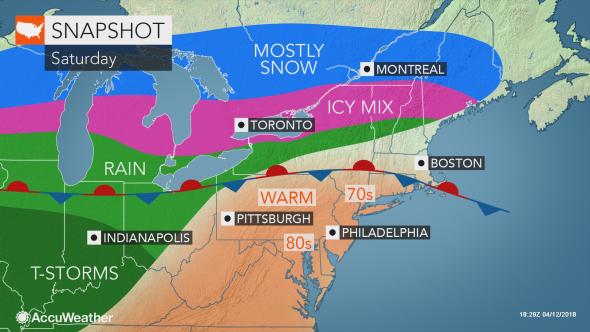
A complex and intense weather system will begin to impact southern Ontario late Friday, with a messy mix of freezing rain and snow. The precipitation will spread into extreme southern Quebec early Saturday. A frontal boundary over central New York will be the focus for the precipitation as it attempts to lift northward on Saturday. Low pressure will then slowly move along the front Sunday bringing another round of precipitation into the region. At the same time, strong high pressure anchored over central Quebec, will provide unseasonably cold air across the region.

Montreal can expect light snow on Saturday, with perhaps 5cm accumulating. The heaviest precipitation on Saturday will be across southern Ontario, where freezing rain and snowfall warnings have been posted. The possibility exists for a significant amount of freezing rain along the north shore of Lake Ontario into the St. Lawrence Valley. Further north snow will be the main form of precipitation. All regions, including Montreal can expect gusty northeast winds up to 60km/h through Sunday. Temperatures will fall below freezing overnight and remain there through most of the upcoming weekend in Montreal. On Sunday, heavier precipitation will arrive in Montreal, with the freezing rain lifting from southern Ontario into southern Quebec. This is a very dangerous late season storm, with  numerous impacts expected across the entire area. On Monday heavy rain is forecast, as the system slowly lifts northeast across Quebec.

I will post further updates early Saturday morning.

Wednesday, April 11, 2018

Challenging weekend forecast may bring snow and freezing rain to Quebec

A stationary front will be the focus of heavy precipitation over the weekend. The front will also represent the dividing line between very warm air to the south and more cold weather here in Montreal. (AccuWeather.com)
A very difficult, complex forecast period lies ahead for portions of southern Ontario and Quebec. Wednesday will likely be the best day of the week, with sunshine and fairly mild temperatures. Clouds will increase this afternoon, as a week clipper system crosses the region. We may have a few spotty showers or flurries along with the cloud cover.

On Thursday, a second weak area of low pressure will follow a similar path across southern Quebec, with light rain expected. Skies will briefly clear on Friday, before the real fun begins. A sharp frontal boundary will position itself across portions of central New York State and New England. North of the front, cold weather will prevail, with temperatures at or slightly below freezing. South of the front, temperatures will surge into the low to middle 20s.  The big question is where will the front settle? As the front meanders across the region through the weekend, strong low pressure will approach from the Midwest US. The storm will be packed with moisture. A mix of heavy wet snow, freezing rain, rain and thunderstorms is expected to develop on Saturday from the central US towards the Great Lakes, Ontario and Quebec. The potential exists for a significant freezing rain event for many, as well as heavy wet snow in some locations. Heavy rain will cause sharp rises in rivers and streams increasing the concern for flooding.

At this time amounts and type of precipitation are very difficult to nail down. One thing is certain, we will have a decent amount of precipitation, perhaps in excess of 50mm (2 inches) through Sunday night. Strong winds are also likely with this storm. Weather watches and warnings will likely be necessary for a portion of our forecast region as the event draws closer. Stay tuned as this will be a fluid event with a highly changeable forecast.

Sunday, April 08, 2018

Chilly start to April to continue across most of Canada

I would like to express my deepest condolences to the residents of Humboldt and the province of Saskatchewan. I was saddened to hear the news of the terrible accident involving the Broncos hockey club. I wish the players, families and first responders strength and courage as they begin the long recovery process.

Strong winds in east end Montreal, toppled this sign onto several cars Wednesday night, April 4. The wind cut power to nearly 50,000 customers in Quebec. (Radio Canada Photo)
April Chill
The miserably cold start to April continues across most of Canada. From coast to coast, Canadians are dealing with cold and snow. The low on Friday morning in Edmonton was a bone-chilling -25C (-13F), the coldest since 1975. The storm on April 4 produced over 25mm of rain in Montreal, but the fierce winds were the real story. Gusts exceeded 90km/h in many parts of Ontario and Quebec, with a peak gust of 89km/h recorded at both Trudeau Airport and south shore St Hubert. In Ontario, the strongest wind was at Point Petre, at 102km/h. In New York, 75mph winds were recorded east of Lake Erie, while a gust to 100mph was measured on Mount Mansfield in Vermont.The wind knocked power out to thousands, including 50,000 in Quebec. There was also reports of structural and tree damage. Heavy snow fell northeast of Montreal, with 27cm at Quebec City. Blowing snow closed Highway 20 east of Quebec City to Riviere-du-Loup.

A tree lies across a house in western New York on April 4. (AccuWeather.com)
Cold, blustery weather followed the storm, with a high in Montreal of only -3C (27F) on Thursday, 4C (39F) Friday and a windy 3C (38F) Saturday. The average high for this time of year should be 9C (48F). Snow showers have been accompanying the cold, making it feel like February.

As we look ahead to the upcoming week, the picture looks the same for southern Quebec and Ontario. Expect below normal temperatures with periods of showers or flurries scattered through the week. At best, high temperatures may reach 7C (45F), still well below normal. Overnight lows will dip below freezing. At this rate, the icy piles of dirty snow still around, may last into May. I just want to rake my lawn!

Monday, April 02, 2018

Strong spring storm to spread snow and rain across Quebec

Where has spring gone? Many parts of Canada as well as the northern US continue to experience cold and snowy weather. More of the same is forecast through at least the middle of April.
Deepening low pressure is forecast to move from Colorado towards the lower Great Lakes on Tuesday. A warm front well in advance of the storm center, will push across the region Tuesday night, followed by a potent cold front Wednesday evening. South and east of the storm track, heavy rain is expected, with 25 to 40mm possible. Heavy rainfall warnings have been issued for southern Quebec, including metro Montreal. North and west of the track, snow will be the dominant precipitation type. Some locations from the upper Ottawa Valley into the Laurentians, may pick up 20 to 30cm of heavy wet snow. Environment Canada has posted snowfall warnings for Mont Tremblant as well as Sainte-Agathe and Saint-Sauvuer. Warnings are also in effect for the upper Ottawa Valley including Pembroke and Petawawa. Portions of western Quebec and extreme eastern Ontario may have mixed precipitation to start late Tuesday, but should transition to rain quickly. Behind the storm, rain will change to snow in Ottawa Wednesday night, with 5cm forecast.

Strong Winds
Temperatures will warm above freezing in Montreal on Tuesday, reaching a high of 4C (39F), with 6C (43F) expected on Wednesday. A strong cold front will arrive late Wednesday into Thursday morning, accompanied by very strong northwest winds. In the St. Lawrence Valley, gusts may reach 90km/h. Wind warnings may be necessary for Montreal late wednesday afternoon. Unseasonably cold air will rush back into southern Quebec, with lows plummeting by Thursday morning to -10C (14F) in Montreal. The cold, unsettled weather will be with us through the middle of the month, with several opportunities for snow across the northern tier of the US as well as central and eastern Canada. The next chance for snow could come as early as Friday morning here in Montreal, as a clipper system moves south of the city. More on that as the week progresses.

Thursday, March 29, 2018

Cold start to April still on tap for Quebec and Ontario

This large tractor seems rather small next to the dirty Dorval snow pile. The towering pile of snirt,  a Prairie term for a snow and dirt mixture, is slowly beginning the long melting process. This will likely last well into May or June. (ValleyWeather)
I am anticipating a mild end to the work week and the start of the upcoming Easter and Passover weekend. Low pressure will approach southern Quebec later today and into Good Friday, with plenty of moisture. Along with the moisture will come a surge of warm air. Expect temperatures to rise to 10C (50F) Thursday, and 7C (45F) Friday. Unfortunately there will also be plenty of clouds and 15-20mm of rain through Friday morning. In the wake of the system, slightly cooler air will arrive late Friday along with clearing skies.

On Saturday, a potent cold front will cross the area late in the day, along with much colder temperatures. The low by Easter Sunday morning will be well below freezing across the entire region. Some light snow or flurries will be possible as well. The high temperature on Sunday will be well below normal, only 0C (32F) for Montreal. Looking ahead to next week, much cooler air is anticipated along with several opportunities for some snow. Temperatures are expected to remain below normal into the second week of the month.

The cold air will extend into the southern Prairies, where record low temperatures are anticipated through Easter weekend. Snow and blowing snow is also forecast from Alberta into southern Saskatchewan, making travel difficult. The snow will extend into the Dakotas and Minnesota as well.

Thursday, March 22, 2018

Spring temperatures slow to arrive in Montreal

Clearing highways in eastern Maryland late Wednesday afternoon. A large area of arctic high pressure has dominated the weather over southern Quebec, keeping the east coast snowstorm shown above, well to our south.
(Maryland DOT Photo)
You must forgive me for actually missing the arrival of Spring this past Tuesday, March 20 at 12:15pm. I was too busy bundling up to walk the dog, in a biting northwest wind and near-record cold temperatures. The first day of spring continued the trend of well below normal temperatures that started late last week. Daytime highs and overnight lows have been running 10 to 12 degrees colder than normal, including the first multi-day freezing weather here in Montreal since February 12th and13th. The first day of Spring, the morning low was -13.5C (8F), missing the record low for the day of -17.8C (0F), set in 1949. That was at Trudeau Airport. Other locations off island were much closer to the record low, including on L'Ile Perrot, where I recorded -17C (1F).

The silver lining to this cold weather, is that the arctic high responsible for it, has been keeping the storm systems to our south and east. The latest nor'easter only sent high clouds across southern Quebec. The system dumped more heavy wet snow from Washington D.C into New York City, with up to 30cm in some locations. The fourth nor'easter in three weeks, send the region into the usual lockdown, with thousands of flights cancelled in anticipation of the snow. Schools and businesses were closed, and rail travel suspended in the northeast corridor.

Montreal can expect partly sunny skies, with moderating temperatures through the weekend, and into next week. High temperatures may reach 10C (50F) by next Wednesday.  A few weak impulses of energy may give southern Quebec a few flurries over the weekend, but no major accumulations are forecast through next week. By late next week into Easter weekend, colder air is forecast to return, along with increasing chances of some snow to start April. Adding to the chill, is the fact that the Great Lakes still have ice covering more than 30 percent of the surface, which may result in a delayed onset of warmer weather.

Thursday, March 15, 2018

The calm after the storm in Montreal

Where is Spring? Allard Avenue in Verdun early Wednesday morning. Over 20cm of wet snow has fallen across metro Montreal since late Tuesday.
(Photo J. Balena)
Low pressure is slowly relaxing its grip on southern Quebec late Thursday afternoon, with partial sunshine developing. This comes after 48 hours of what seemed like endless snow. Storm accumulations were very impressive across our area, with 20 to 30cm across metro Montreal, the highest snowfall as expected, occurring south of the city. The mountains of northern Vermont and New York were buried under several feet of snow over the last few days. A special weather statement from the National Weather Service in Burlington Thursday afternoon, even hinted at an elevated risk for avalanches in the region. Keep this in mind if you have ski plans this weekend. The most recent storm is slowly spinning across eastern New Brunswick, forecast to move out of the region on Friday.

In the wake of the storm, unseasonably cold air will begin to filter into Montreal. Skies will be partly cloudy on Friday, but it will be cold with overnight lows near -7C (19F) and daytime highs at -2C (28F). A cold front arrives Saturday, accompanied by snow flurries and perhaps some brief squalls. Much colder air will arrive behind the front on gusty northwest winds. The high Saturday will be -5C (23F), with an overnight low of -16C (3F). Sunday will remain breezy and cold, with a very slow moderation in temperatures. After the mild weather of the last few weeks, this cold snap will feel brutal. As we look ahead to next week, a fourth coastal storm is expected to develop by late Tuesday and possibly impact New England. At this time it is too early to tell if we will experience any weather form the system.

Tuesday, March 13, 2018

Storm to bring 10 to 25cm of snow to southern Quebec

The third storm in the last two weeks is producing heavy snow in New England on Tuesday. (Cohasset Police Photo)
Snowfall Warning in effect for Vaudreuil/Dorion, Eastern Townships/Beauce

The latest in a series of east coast storms is pounding New England Tuesday afternoon with heavy wet snow and strong winds. The strengthening storm was located east of Cape Cod at 2pm, forecast to move northeast towards Nova Scotia before curling northwest into eastern Quebec on Wednesday.

Snowfall warnings are now in effect for Vaudreuil/Dorion southward to the US border. Warnings have been posted for the Eastern Townships and Beauce regions as well. Widespread storm warnings are also in effect across New England and New York. A special weather statement is covering the snow in southeast Ontario. Travel will become poor across the entire area later today and especially tonight.

Light snow has already fallen across southern Quebec Tuesday, but is expected to intensify this afternoon and tonight, as a trough of low pressure draws moisture inland form the coastal storm. Heavy wet snow Tuesday tonight and Wednesday will accumulate 10 to 15cm in Montreal, with 15 to 25cm across the warned regions south of the city. The highest accumulations will be found across the higher elevations, with some melting occurring in the city. Strong northeast winds are also forecast to develop, gusting between 30-60km/h in the St. Lawrence Valley through Wednesday. The temperature will remain steady through the period, between 1C and -1C (28 to 33F). Light snow is expected to persist into Thursday.

Consider postponing non-essential travel south and east of Montreal tonight.

Monday, March 12, 2018

The parade of storms continues for the east coast

Montreal will be on the western edge of another coastal storm this week. Snow may accumulate 10 to 20cm over a 48-hour period starting Tuesday.
The third Nor'easter in the last ten days is poised to take aim at New England this week. Low pressure is expected to develop off the Carolina coast on Monday, and rapidly deepen as it moves east of Cape Cod on Tuesday. Following a track very similar to the previous storms, the bulk of the snow is expected to fall across southern and eastern New England, southeastern Quebec and portions of Atlantic Canada. Strong winds and pounding surf are forecast for the same regions that are still trying to restore power and repair coastal infrastructure. As far as snow goes, 20 to 40cm (8 to 16 inches) is likely, across the far Eastern Townships south and east into New England.

Long-duration snowfall for Montreal
Once again, the current track keeps Montreal and eastern Ontario on the western periphery of the heaviest precipitation. However, this time, an upper-level low over the Great Lakes will draw moisture from the coastal storm into southern Quebec starting Tuesday. A long-duration snow event is expected, with periods of light snow lasting into Thursday. This is a very complicated setup, and combined with the warming March sun, makes amounts difficult to predict for Montreal. For example, I anticipated more snow last week, but the heaviest amounts remained east of the city. What did fall melted very quickly. If I had to estimate accumulations at this time, they would fall into the 10 to 20cm (4 to 8 inches) range for southern Quebec. As with last week, given temperatures near the freezing point, this may be generous. We will have to keep a close eye on the exact track of the storm and how quickly cooler air is pulled in behind the storm this week. This forecast is subject to major adjustments... stay tuned!

Thursday, March 08, 2018

Nor'easter buries New York, New Jersey & New England

Heavy snow piles up in Morristown, New Jersey Wednesday night. The second storm in less than a week, dumped over 60cm (2 feet) of heavy wet snow on the region. The system has largely avoided southwestern Quebec so far, with only a few centimetres falling. (Photo: The Weather Channel)
The second nor'easter in less than a week buried portions of the east coast on Wednesday. Heavy wet snow fell from Pennsylvania across New Jersey and New York and into New England. The hardest hit regions were from southern Vermont across the lower Hudson Valley into central New Jersey, where as much as 70cm of snow fell. In some locations, the snow was falling at more than 10cm (4 inches) per hour late Wednesday. Thunder, lightning and strong winds accompanied the snow. As of Thursday morning, nearly 750,000 homes and businesses were without power in New England and the Northeast. Air and rail service have been greatly impacted from Washington to Boston. Several highways are closed due to multiple accidents, downed trees and power lines and deep snow.

The storm responsible for all the weather is now moving into Maine, likely to deliver 10 to 30cm of snow to portions of New Brunswick and eastern Quebec. A last minute wobble of 30 to 50 miles to the east, managed to spare Montreal any real impacts from the system so far. As of 7am this morning, I had measured 2 to 3cm of snow on L'Ile Perrot. As the storm moves into New Brunswick, it is expected to weaken today and retrograde westward towards Montreal by late Friday. What this means locally, is intermittent light snow throughout Thursday and Friday, perhaps persisting into Saturday. Accumulations may reach 10cm in many regions of southern Quebec, including metro Montreal, but falling over a 36 hour period, I am not expecting any major impacts. Winds will be gusty in Montreal on Thursday, out of the northeast 30-50km/h. Expect temperatures to remain either side of 0C (-2C to +1C) over the next 36 hours.

Wednesday, March 07, 2018

East coast storm to impact Montreal & southern Quebec

Montreal will remain on the extreme western edge of the latest coastal storm. (AccuWeather.com)
As municipal and utility crews, including Hydro Quebec, continue the massive clean up form last Fridays's storm, another is taking aim at the east coast. Power is still out for many, with the second storm excepted to hit today. Low pressure is developing Wednesday morning, east of New Jersey. This system is forecast to strengthen rapidly and move across Cape Cod and into Maine on Thursday. Another round of strong winds and heavy surf is expected for coastal communities still reeling form the last storm. A wide area of precipitation is spreading north this morning, expected to arrive in southern Quebec and Montreal by the evening commute.

Widespread winter storm warnings are in effect for all of New England and eastern New York, extending into southeastern Quebec, including the Townships, through Thursday evening. A special weather statement covers the snow forecast from Montreal south to the American border. If the forecast track remain accurate, Montreal will be on the edge of the heaviest snow, with 5-10cm (2-4 inches) likely in the city, and 10-15cm (4 to 6 inches) form Vaudreuil south into New York. Southeast of Montreal along Highway 10, expect heavier snow, with 15-25cm (6-10 inches) possible by late Thursday. Travel in that region is not advised. The snow for all regions will taper to flurries late Thursday, and persist into Friday as the system slowly weakens and moves into Quebec.

Winds will be another factor with the snow, especially here in the St. Lawrence Valley, where they will gust over 50km/h. The temperature throughout the storm should remain fairly steady in Montreal, between 0C and -2C (28 to 32F).

Monday, March 05, 2018

Next coastal storm to impact southern Quebec

Hydro Quebec crews are currently on the ground in southern New York, helping restore power to some of the nearly 2 million homes affected by last weeks storm. (Twitter @HydroQuebec)
We have a very active weather week ahead for southern Quebec and New England. I will start by taking a brief look back at the storm that just left us. The powerful nor'easter pounded the southern New England coast with heavy surf and widespread coastal flooding. Strong winds, gusting over 120km/h brought down thousands of trees and power lines from the Carolinas to Maine. At the height of the storm, over 2 million homes and businesses were without power. Hydro Quebec was contacted in advance of the storm by local utilities, and responded with 108 teams, comprising 220 employees. The teams are scattered around New England, but are mostly located along the souther tier of New York state, near the Pennsylvania border. This region received over two feet (60cm) of heavy wet snow. Infrastructure took a big hit in coastal communities, including Hampton Beach, New Hampshire, where roads were washed out. Further south in Massachusetts, beaches were swept away and numerous homes damaged. Seven deaths were blamed on the storm.

Powerful winds and pounding surf caused widespread damage from New England to the Carolinas. The photo above was taken in Tewksbury, Massachusetts. (Tewksbury Police Photo)
Over the weekend, what was left of the system, drifted into the Atlantic, but had enough moisture left over to interact with an upper level disturbance over southern Quebec and eastern Ontario. As a result, cloud cover dominated our weather, along with light snow. Some locations reported as much as 5cm of wet snow.

The next storm is on the horizon, expected to produce heavy snow for many regions of Quebec. (AccuWeather.com)
Looking ahead to this week, another major system is forecast to develop on Thursday along the east coast. This system will not be as strong as last weeks storm, but still have an impact on our weather. Depending on the exact track and proximity to the coast, some locations in southern Quebec may have a significant snowfall. At this time, the heaviest snow, in excess of 20cm (8 inches), will likely fall across the Townships, areas near the US border and in New England. Winter storm watches are already in effect across upstate New York and most of New England.

Snow will arrive in Montreal early Thursday and persist into Friday. I am thinking a general 10cm is likely for Montreal, but that is subject to change. Look for updates throughout the week as the picture becomes clearer regarding this storm.

Thursday, March 01, 2018

Powerful coastal storm to graze southern Quebec

So close and yet so far. Southern Quebec will remain on the northern edge of another coastal storm. Only flurries and strong winds are forecast Friday for Montreal. (AccuWeather.com)
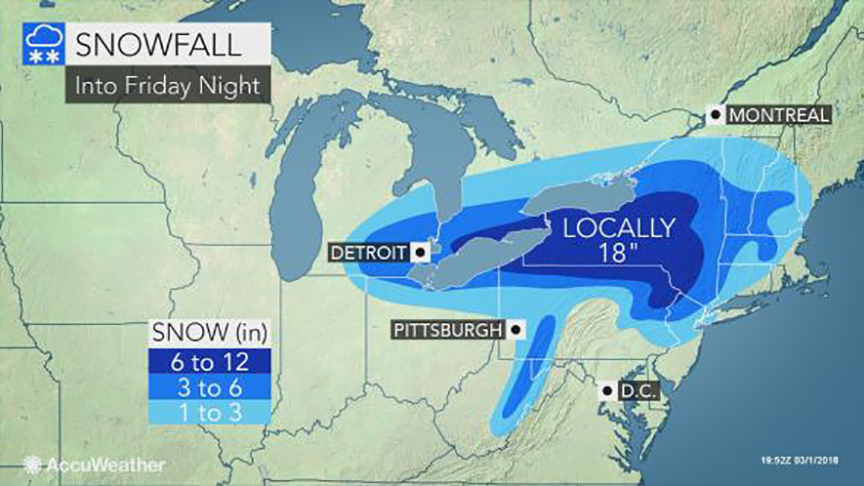
Strengthening low pressure will slide across the state of New York overnight, delivering heavy snow and strong winds from Michigan into southwest Ontario and New York. The storm will move off the New Jersey coast on Friday and rapidly deepen into a major Nor'Easter.

Tonight, the bulk of the heavy wet snow will fall from Windsor, Ontario eastward into the Niagara region as well as the Adirondacks. A general 10-30cm of snow is expected. Strong winds will gust over 50km/h, producing poor visibility. On Friday, the axis of heaviest precipitation will occur across New England and the northeast. Southern Quebec will remain on the extreme northern edge of the storm, with flurries and strong northeast winds developing Friday. Wind gusts may exceed 70km/h in the St. Lawrence Valley. The clouds and gusty winds will hold temperatures either side of 0C (32F) through Friday. Any snow accumulations will be in the order of 2cm, and confined to the regions south of Montreal.

Damaging Storm
Along the southern and eastern New England coastlines, residents are preparing for a major storm. Winds are expected to gust to hurricane force, 75mph or higher. Coastal flooding will be a major concern as the storm slowly moves into the Atlantic. Three successive high tides are expected during the duration of the storm, each pushing a tremendous amount of water onto the coast. Evacuations may be needed in several locations. Severe coastal impacts are expected. In addition to the wind and waves, 50 to 100mm (2-4 inches) of rain is possible. Widespread power outages are likely. The hardest hit area at this time is expected to be along the Massachusetts and Rhode Island coast.