Monday, September 30, 2019

Historic snowstorm hammers southern Alberta and Saskatchewan

A rare September snowstorm dumped over 90cm of thick wet snow on southwest Alberta over the weekend. (Photo via Twitter @rbgibbfarms and The Weather Network)
A three day historic September snowstorm is winding down early Monday morning across southern Alberta and southwest Saskatchewan. The storm dumped huge amounts of wet snow across the region, with close to 100cm (40 inches) in Waterton Park, Alberta. Lethbridge recorded 45 to 55cm, with 31cm in Calgary. On Sunday alone, 24.6cm of snow fell in Calgary, breaking the single day September record of 22.9cm established on September 19, 1895. The storm responsible for the snow was packed with Pacific moisture, moving inland across Idaho and into Montana.

Across the border in northwest Montana, even more snow fell, with an unbelievable 122cm (48 inches) at Browning, Montana. Brownings average annual snowfall is 151cm (59.5"), and we are not even out of September! The storm produced the usual mid-winter problems, with major travel delays and power outages reported. Numerous trees fell under the wight of the heavy snow.

Northern Montana measured even more snow than Alberta. (via Twitter @aaronjayjack)
Snow also fell across southwest Saskatchewan on Sunday, with accumulations in the 15 to 25cm range forecast from Moose Jaw and Swift Current south towards the US border. It is common for snow to fall on the edges of the seasons in Saskatchewan, but the amount, intensity and duration experienced with this storm are rare. When I lived in southern Saskatchewan between 1997 and 2000, the two biggest snowstorms I encountered were in October and May.

Warm weather in the east
While the snow was swirling across the west, warm and humid air surged into eastern North America. Dozens of records highs were set across the eastern US, with highs pushing into the middle 30s (90s) in many locations. Temperatures were quite warm in southern Ontario over the weekend, but slightly cooler here in southern Quebec. The weather in Montreal for the start of October will be quite unsettled. Showers and thunderstorms are likely Tuesday, along with mild high temperatures in the low 20s. By the end of the week, much cooler arrives on gusty northwest winds, with highs by Friday and Saturday only in the low teens.

Friday, September 27, 2019

Huge snowstorm for parts of western Canada - mild weather continues in the east

The first snowstorm of 2019 is forecast to dump 25 to 60cm of wet snow on southern Alberta, interior portions of southeastern B.C. and adjacent Montana over the weekend. (NWS Photo)
I apologize for the lack of weather talk in recent weeks. I hate it when real life gets in the way of my chosen passion. A few extra responsibilities here at The Suburban have kept me from writing as much as I would like to.

Thankfully the weather has been fairly quiet over the last few weeks in Montreal. September has been beautiful across southern Quebec, an extension of the summer really. As with the past few years, September has become just another summer month, with average temperatures running above normal, into the lower to mid 20s. We have yet to see frost in metro Montreal, which is normal. We should see some colder nights over the next couple of weeks that will help the leaves along with their colour and also produce some frosty mornings. Daytime temperatures will remain at or slightly above normal through the weekend across southern Quebec.

Precipitation has been above normal for September, with 93.4 mm to date. Showers are forecast on Saturday and once again late Monday, which should allow Montreal to exceed 100mm (4 inches) for the month.

Historic Snowstorm
The big weather news this weekend will be the historically early snowstorm expected to impact portions of interior British Columbia, southern Alberta and northwest Montana. A strong Pacific storm will move into the Rockies over the weekend, combining with an unseasonably cold airmass. The result will be heavy wet snow along the spine of the Rockies and into the foothills west of Calgary. Snow is forecast to start late Friday and persist in some locations into early Monday. Some computer models are estimating as much as 50cm of snow across southwest Alberta. Winter storm watches have been issued. The heavy wet snow will fall on trees that are still in full bloom, with the possibility of major damage occurring. Power outages and very poor travel conditions are expected as well, especially west of Calgary along the Trans Canada Highway into B.C. Strong winds are also forecast with the storm, in excess of 100km/h. The same conditions are forecast in northwest Montana where weather warnings are already in place.

The weather is eerily similar to that of fall 2018, when a massive snowstorm hit Calgary southern Alberta on October 2.

Sunday, September 15, 2019

Perfect weather to end summer in Montreal

The full harvest moon rising over the St. Lawrence River in Montreal. Perfect late summer weather is expected this week to end the season. (Valley Weather Photo)
After a rather cool, wet start to September, southern Quebec is in for a stretch of spectacular late summer weather. Temperatures so far this month have been relatively close to normal, averaging either side of 21C (70F) for highs, with lows around 10C (50F). The precipitation to date has been well above normal. On Saturday, a frontal system produced a round of showers through mid-morning, dropping another 7 to 10mm of rain on the Island of Montreal. That brought our monthly total up to 79.4mm, which is very close to the normal  for the entire month of 83.1mm.

The good news is dry weather is on the horizon as strong high pressure is forecast to crest over southern Quebec and eastern Ontario this week. Expect mostly sunny skies, with cool nights and warm afternoons. The temperatures will rise through the week, reaching close to 27C (80F) by next Saturday. No rain is in the forecast this week, with just some periodic cloudy periods expected at times today and Monday.

Fall arrives on Monday, September 23 at 3:50am, so get out and enjoy the upcoming week.

Tropical Storm Humberto
The follow up to catastrophic hurricane Dorian has been more of a nuisance than anything so far. Tropical storm Humberto was located 220km north, northwest of Great Abaco Island on Sunday morning, with 100km/h winds. Humberto added to the misery on Great Abaco Island Saturday, producing breezy conditions and rain in the storm stricken region. Humberto is expected to strengthen to hurricane status within the next 24 hours, but is thankfully moving away from the Bahamas. The storm may impact Bermuda later in the upcoming week.

Conditions continue to be dire in The Bahamas, with a mounting death toll and hundreds still missing. If you can help, please consider donating to the Canadian Red Cross Hurricane Dorian Appeal at this link.

Sunday, September 08, 2019

Dorian slams Atlantic Canada - will finally dissipate in North Atlantic this week

A vehicle lies crushed by a roof torn from a Halifax building by Hurricane Dorian's 145km/h winds. (CBC)
Hurricane Dorian roared inland near Sambro Creek, Nova Scotia, just south of Halifax, around 6:15 pm Saturday evening. The category 2 storm, the first of that strength in Canada since Juan in 2003, swept across the province tearing down trees and power lines. A storm surge swept into Halifax Harbour and many neighbouring communities producing damaging flooding. The combination of wind and debris knocked out power to over 500,000 homes at the height of the storm. Numerous trees were torn from their roots by the powerful storm, blocking roads and crushing roofs and vehicles. A large construction crane was twisted and knocked down in Halifax. Schools across Nova Scotia and Prince Edward Island will be closed on Monday, allowing crews to continue the damage assessment and cleanup.

A construction crane was toppled in downtown Halifax by Dorian's fierce winds. (CBC)
Peak winds observed with Dorian across the Maritimes were 145km/h at Beaver Island, Nova Scotia, 107km/h at Halifax, and 122km/h at North Cape, Prince Edward Island. Heavy rain occurred as well, with 121mm in Moncton, 138mm in Oxford and 90mm in Halifax.

Dorian also produced 120km/h winds across Iles-de-la-Madeleine, Quebec, where widespread damage was reported. A state of emergency is in effect, with power out to over 7000 residents. Hydro Quebec has 30 employees on the islands to complete the restoration.

Dorian is now impacting Newfoundland and coastal Labrador, with 100km/h winds. The storm was located 100km west, southwest of St. Anthony, Newfoundland at 6pm, moving northeast at 37km/h. After the storms two week run of damage and death, Dorian is finally forecast to weaken as it moves into the North Atlantic early this week.

Saturday, September 07, 2019

Hurricane Dorian to sweep across Nova Scotia today

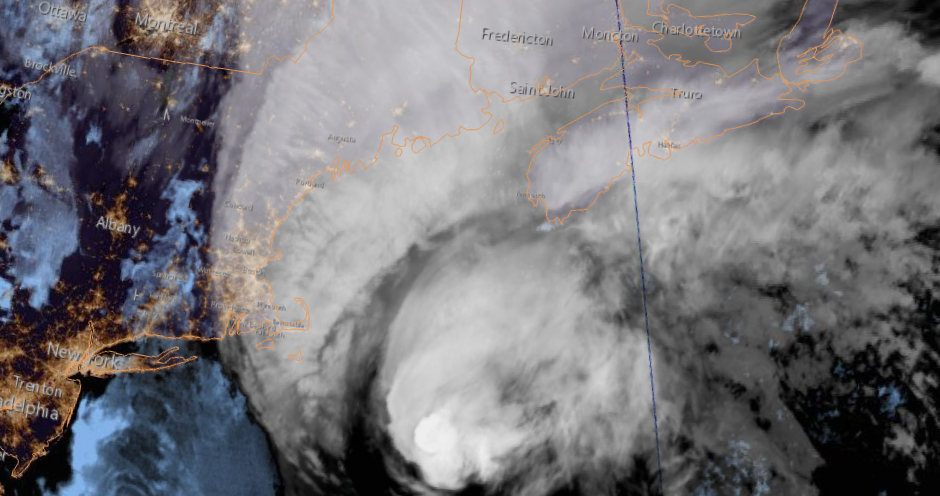
NOAA image of Hurricane Dorian located east of Cape Cod and south of Nova Scotia early Saturday morning. (NOAA)
Early Saturday morning, hurricane Dorian was located 660km southwest of Halifax, racing towards the northeast at 41km/h. Dorian has still maintained category 1 status, with winds gusting to 140km/h. Hurricane warnings are in effect for Nova Scotia and P.E.I., with tropical storm warnings posted for portions of New Brunswick, Newfoundland and eastern Quebec. Montreal and southern Quebec will have no weather impacts from Dorian.

Ocracoke Island, North Carolina was inundated by a 7 foot storm surge produced by Dorian on Friday. The tiny barrier island sustained major damage as did neigbouring Hatteras Island. (Hyde County Sheriff Office)
Waves and winds are increasing along the south coast of Nova Scotia Saturday morning, with hurricane conditions expected in Halifax by late this afternoon or this evening. At this time, most locations in the warning area should see winds of  90 to 120km/h, but gusts up to 150km/h are possible along the coast. Heavy rain will fall along and west of the track, with up to 150mm possible. Flooding will be a major concern in western Nova Scotia ans southern New Brunswick. A storm surge of  several metres is expected, especially along the south coast of Nova Scotia and in the Gulf of St. Lawrence. Waves of 5 to 10 metres are also likely in the warning area. Flooding, tree damage and power outages as well as some structural damage are major concerns today across the Maritimes. Dorian will move into Prince Edward Island tonight and across the Gulf of St. Lawrence on Sunday morning.

Dorian will  then begin to transition into a powerful post-tropical storm Sunday as the system moves rapidly across Newfoundland and into the North Atlantic.

Wednesday, September 04, 2019

Dorian devastates The Bahamas heads for the Carolina coast

Hurricane Dorian caused the complete and total destruction of most dwellings on Great Abaco and Grand Bahama Islands in The Bahamas. The storm spun over the islands for over 36 hours. (US Coast Guard Photo)
Paradise lost...
Complete, unprecedented damage is what is left behind on Great Abaco and Grand Bahama Islands after 48 hours of fierce winds and pounding seas from hurricane Dorian. The once category 5 hurricane battered the northwest Bahamas with a 20 foot storm surge and 185 mph winds through the weekend and into Monday. The damage is just incredible, with most structures simply gone. Cars and boast are submerged, power lines and trees ripped form the ground. The death toll stands at 20, but is likely to climb as rescue workers arrive in the hardest hit areas.

The US Coast Guard has conducted numerous rescues, in some cases pulling people from rooftops after several days. Both islands were completed inundated with the storm surge. Relief is pouring in from several countries including Canada, which has pledged $500,000, with additional aid to follow.

The eye of hurricane Dorian was located off the Georgia coast late Wednesday afternoon. (NOAA)
Dorian skirted the Florida coast on Wednesday, bringing storm surge flooding and heavy rain, but damage was minor. Hurricane Dorian at 8pm Wednesday evening was located 410km south southwest of Wilmington, North Carolina, with 175km/h winds. Dorian is moving northwest at 15km/h, with a gradual turn towards the northeast forecast on Thursday. The hurricane is expected to remain just offshore of the southeast US coast, perhaps making landfall along the Outer Banks of North Carolina. A hurricane warning extends northward to the Virginia border. Heavy rain in excess of 200mm is forecast along the track of the storm. Storm surge flooding is also expected along coastal areas.

Dorian to hit Atlantic Canada
By Saturday, hurricane Dorian is expected to sweep into the Maritimes with significant impacts. The Canadian Hurricane Centre is predicting winds of up to 140km/h as well as heavy rain, in excess of 50mm for portions of Nova Scotia and Newfoundland. Storm surge flooding is also expected in coastal communities. Far eastern Quebec will also receive rain and gusty winds from Dorian. Montreal will be too far west for any weather from the storm, with the exception of perhaps a gusty northeast wind filtering down the St. Lawrence Valley. The current forecast calls for Dorian to move across central Nova Scotia by late Saturday afternoon, approaching Newfoundland by early Sunday.

Sunday, September 01, 2019

Dorian strongest Atlantic hurricane in modern times to hit The Bahamas

Images shared on social media show widespread damage and flooding on Great Abaco Island in the northern Bahamas.
Hurricane Dorian became a monster storm Sunday, tearing apart Great Abaco Island for most of the day. The storm exploded early this morning, reaching category 5 status and beyond. Dorian became the strongest hurricane in modern times to strike The Bahamas, and one of the most intense on record in the Atlantic basin. Peak winds reached 185mph, and have since lowered only slightly to 180mph (285 km/h) as of the 11pm observation Sunday night.

Dorian became one of the strongest hurricanes on record in the Atlantic basin today, as winds reached 185mph. (Tropical Tidbits)
Dorian is crawling achingly slowly at 9km/h, prolonging the battering the northern Bahamas is sustaining. The slow movement has resulted in massive flooding, power outages and the complete failure of most structures. Images and video shared on social media show tremendous damage on Graeat Abaco Island. The storm is now impacting Grand Bahama Island and Freeport. Catastrophic damage is expected in those locations as the winds scour the region overnight and into Monday.

Winds and waves will increase on Labour Day along the Florida coast as Dorian inches dangerously close to a US landfall. Forecasters expect that Dorian will remain just offshore, however just a slight wobble would bring the eye inland along the central Florida coast. As of late Sunday, hurricane warnings were now in effect along the Florida coast and evacuations were ordered in several counties.

Briefly looking ahead, Dorian is expected to sweep the southeast coast as far north as the Outer Banks. While weakening is expected, Dorian will remain a very dangerous hurricane for most of the upcoming week.

Category 5 Dorian battering northern Bahamas

A textbook image of category 5 hurricane Dorian early Sunday morning. (Tropical Tidbits)
Early Sunday morning, hurricane Dorian was upgraded to a powerful category 5 storm, with winds of  260km/h (160 mph). The storm is battering the northwest Bahamas, and expected to do so through Monday. The slow moving hurricane is drifting west at 15km/h. Dorian was located 55km east of Great Abaco Island. Catastrophic damage from wind, rain and storm surge is possible with a category 5 storm.

Hurricane warnings remain in effect for the northwest Bahamas, while a tropical storm warning is in effect for the Florida coast from  Deerfield to Sebastian Inlet. A tropical storm watch is in effect north to Golden Beach. Winds and waves will begin increasing along the Florida coast late tonight and on Labour Day.

Some computer models now have Dorian remaining off the Florida coast and turning sharply north then northeast early this week. The hurricane now poses a serious threat to the North and South Carolina coast, including the extremely fragile Outer Banks. A state of emergency remains in effect for Florida, Georgia and the Carolinas.

Saturday, August 31, 2019

Powerful hurricane Dorian threatens Bahamas and Florida

A stunning infrared image of hurricane Dorian early Saturday morning. Dorian was located 755 km east of the Florida coast at 5am. (Tropical Tidbits)
Early Saturday morning, powerful category 4 hurricane Dorian was located 755 km east of West Palm Beach, Florida. The storm was in a very favorable environment to maintain the current strength or perhaps even grow slightly. Winds were measured at 220km/h (140 mph) with higher gusts. Dorian was moving west northwest at 20km/h.

Developments over the last 24 hours have included a hurricane warning for the northwest Bahamas, as well as mandatory evacuations of the barrier islands of Brevard County, Florida. Some coastal communities in Florida have also issued voluntary evacuations for those who wish to leave early. There has been a run on water and gas in south Florida, and those items are in short supply. Portions of the Florida coast may see a hurricane watch issued some time Saturday.

As far as the future of Dorian goes, the path is not so clear. The storm is forecast to slow to a crawl as it approaches the Bahamas, thus prolonging the devastating impacts for that region. Dorian may take the entire weekend to clear the Bahamas before approaching the Florida coast late Labour Day Monday or Tuesday. A strong ridge of high pressure that has been forcing Dorian west, may begin to erode allowing the storm to turn towards the north. Some computer models now have the hurricane remaining off the Florida coast and moving north into South Carolina before impacting the Outer Banks of North Carolina. NOAA Hurricane Hunters are scheduled to fly into Dorian several times Saturday, relaying vital information to help with the forecast track.

Dorian remains a very dangerous storm, posing several widespread threats from The Bahamas to Florida and north towards Virginia.

Friday, August 30, 2019

Strengthening hurricane Dorian takes aim at south Florida

A visible satellite image of a strengthening hurricane Dorian, located east of the Bahamas on Friday morning. (Tropical Tidbits)
Hurricane Dorian now a major category 3 storm.

Hurricane Dorian is forecast to become a powerful category 4 storm over the Labour Day weekend while crossing the northwest Bahamas on the way to south Florida. Dorian was located 1000 km east of West Palm Beach, Florida at 2pm Friday, with 185km/h (115 mph) winds. The hurricane was moving northwest at 17km/h. Dorian will be in an ideal environment for strengthening over the next 48 hours, with forecasters expecting a major hurricane at landfall. Water temperatures are very warm in this part of the Atlantic Ocean and wind shear aloft, which can tear apart storms, is expected to diminish.

So far the damage from Dorian has been minor, with mostly flooding and power outages reported in the Virgin Islands. That may change for Florida and the Bahamas as the storm begins to rapidly intensify. (bvitraveller.com)
The big question is where is Dorian going? The forecast has become more complicated over the past 12 hours, with models expecting the storm to slow to a crawl as it approaches the Florida coast. A slow storm at landfall is bad news. This will prolong the heavy rain, strong winds and pounding surf. A long duration onshore flow will lead to significant coastal flooding. Dorian is expected to slowly move into Florida by Labour Day, before turning northward and moving into Georgia and the Carolinas. Dorian will impact the southeast US from late this weekend well into next week. A state of emergency has been declared in Florida and Georgia, with preparations well underway.

I will continue to monitor the progress of Dorian, providing updates via my Valley Weather Blog as well as at The Suburban Weather Page.  For the most complete and accurate tracking information, you can visit the National Hurricane Center website.

On a personal note, September 2019 marks 40 consecutive years that I have been tracking Atlantic Hurricanes, starting with Hurricane David in 1979.

Wednesday, August 28, 2019

Tropical Atlantic heating up

A NOAA GEOCOLOR image of Tropical Storm Dorian in the US Virgin Islands early Wednesday morning. The storm will likely reach hurricane status today before approaching Puerto Rico later today. The system may impact Florida or the US southeast by the weekend.
As a kid growing up, Labour Day meant a few things to me. There was the end of summer and back to school, a moment I despised, I am after all a huge fan of summer, always have been, the Jerry Lewis Labour Day Telethon, which ran for decades, and of course tracking hurricanes. It seems the Labour Day long weekend and hurricanes go hand in hand. I have been tracking the storms since 1979, and rarely a year goes by without a named storm to end the summer. We are in the peak of Atlantic hurricane season, so it is no surprise that we are dealing with two storms as we end August.

Tropical storm Dorian, the more dangerous of the two systems, is located 140km southeast of St Croix in the US Virgin Islands early Wednesday morning. The storm is moving northwest at 20km/h, heading towards Puerto Rico. Winds are gusting to 60mph (95km/h), with some strengthening forecast today. Dorian is expected to become a hurricane as the system moves near Puerto Rico. By the upcoming weekend, the storm will be approaching the northwest Bahamas and the central Florida coast, likely as a hurricane. All interests form the Carolinas into Florida and the Gulf of Mexico should continue to monitor the progress of this storm.

Meanwhile further north, Tropical depression Erin has developed about 430 km east of Cape Hatteras, North Carolina. Erin is a weak system located within a more harsh environment. Erin has 55km/h winds and is forecast to strengthen while moving northeast today. The storm will approach the Nova Scotia coast by late Thursday as a post-tropical system, with gusty winds and heavy rain. Weather warnings will likely be required for a portion of Atlantic Canada by later today.

Thursday, August 15, 2019

Music, peace, love and the weather - Woodstock 1969

Max Yasgur's dairy farm near Bethel, New York became a sea of deep mud after thunderstorms rolled across The Woodstock Music and Art Fair on Sunday, August 17, 1969. (AccuWeather.com) 
Today marks the 50th anniversary of The Woodstock Music and Art Fair in upstate New York.

Starting Friday, August 15, 1969, the residents of the small Catskill village of Bethel in Sullivan County, New York had no idea what hit them. A storm of some 400,000 young adults descended on the village, White Lake and Max Yasgur's dairy farm for what would be, arguably, the largest concert in history.

The Woodstock Music Festival, held August 15 to 18, 1969, was a gathering of a generation focused on peace, love, music and united in their disapproval of government and the Vietnam War. Performers included Jefferson Airplane, Joan Baez, Santana, The Who, Crosby Stills and Nash, Jimi Hendrix and Janis Joplin to name just a few. Some of the performances remain legendary. I can't get White Rabbit out of my head after seeing footage recently. But it was the huge crowds, traffic jams and the weather that dominated the weekend headlines. Expecting around 100,000 to attend, organizers were plagued with problems from the start, including a late venue change, a shortage of food and major sanitation issues. Roads to the site were congested beyond words, with most attending forced to walk to White Lake. Yasgar's farm was just too large to enforce ticket sales, so the venue became wide open to anyone who wished to attend. And attend they did.

Organizers were challenged by major problems from the start, but somehow managed to carry off the event with little violence, this despite a lack of food, bathrooms and an excess of drugs. The Town of Bethel was expecting less than 50,000 to attend. In the end, crowd estimates were between 400,000 and 500,000 for the four days.

The Weather
The weather started off perfect, sunny and warm on August 15, but rain quickly became a major issue. We have all seen the famous pictures of attendees frolicking in deep mud. The concert was only scheduled to run Friday through Sunday, but carried over into Monday due to lengthy delays caused by thunderstorms.

The weather in the region is very similar to that of southern Quebec. Bethel is located about 540 kilometres south of Montreal. August is typically a warm and humid month, with frequent showers and thunderstorms. August 1969 was no exception. The weekend was relatively mild with daytime highs near Yasgur's farm ranging from 26C to 28C (79F to 83F). Overnight lows started quite cool, 12C (54F) on August 15th, but warmed to 18C (64F) by Monday morning. The temperatures were not the story. Day 1 was dry, but low clouds, drizzle and showers were reported on Saturday. In between the showers were peaks of sunshine, along with very warm and muggy conditions.

For comparison, Montreal's high temperatures that weekend were 31C, 32C, 28C and 25C respectively from August 15 to 18. We also had a major thunderstorm on August 18, that dumped 46.7mm of rain on the city.

Rain equals mud
On Sunday, just shortly after Joe Cocker finished his performance, a large thunderstorm swept across White Lake and Bethel, dumping over 25mm (1 inch) of rain near the venue. There was wild lightning and strong winds. Organizers were forced to cover precious electronic equipment and move people off the stage and the huge metal lighting towers that surrounded it. Yasgur's fields were transformed into a sea of mud and subsequently destroyed by the huge crowds. As with the precipitation on Saturday, the storms delayed the performances until at least 6:30pm. The damp, muddy conditions thinned the crowds a touch, as the music continued throughout the night. Monday dawned partly cloudy, as Jimi Hendrix belted out the Star-Spangled Banner before Woodstock drew to a close.

It would have been a miracle for the entire weekend to be rain-free. It is very rare here in southern Quebec and across the border in upstate New York State to have consecutive dry days in August.

Hurricane Camille quickly shifted media attention away from Woodstock and Upstate New York and down to the Mississippi Gulf Coast. The storm levelled the region on the evening of August 17-18, 1969. Camille, and later Katrina in 2005, remain the benchmark storms for the US. (extremeplanet.me)
Hurricane Camille
Another historic event quickly drew attention away from Woodstock late in the weekend. Hurricane Camille plowed into the Mississippi Gulf Coast in the early morning hours of August 18. The compact but powerful category 5 hurricane moved inland near Waveland, Mississippi with 175mph winds and a storm surge of 24 feet. Camille was the benchmark storm that all other were compared to in the Atlantic basin until Katrina in 2005. Camille remains the second-strongest storm on record to impact the United States, and was responsible for 259 deaths and $1.43 billion in damages. Large portions of the Mississippi coast were destroyed beyond recognition. The storm then swept north into Virginia, generating catastrophic flash flooding and claiming more lives.

Tuesday, July 30, 2019

Thunderstorms ease heat and humidity in southern Quebec

A gust front along the leading edge of thunderstorms swept a wall of dust and debris across the Trans-Canada Highway around 1:45pm Tuesday afternoon. Winds gusted between 50 and 90km/h with this storm. (ValleyWeather Photo)
Strong thunderstorms swept across southern Quebec Tuesday afternoon, helping to ease the heat and humidity present since the weekend. Temperatures have been soaring into the low 30s, with little relief during overnight hours, as lows only dropped only into the low 20s. The 4 day heatwave generated heat warnings across Ontario and Quebec, with humidex values approaching 40C.

The storms produced very little rain in Montreal, with only 1mm falling at my home on Ile Perrot. The wind was the big story, gusting up to 90km/h in many locations in southern Quebec, and generating a wall of dust as the storm swept across Dorval and Ville Saint Laurent around 1:45 p.m. There were reports of small hail in Vaudreuil-Dorion, and as many as 48,000 hydro clients were without power at the height of the storm. That number is down to 17,000 as of 9pm Tuesday night. In Rigaud, lightning struck a tree knocking it onto a tent trailer at Camp Choisy. Two injuries were reported.

Slightly cooler weather is expected for the balance of the week, with much lower dew points and humidity. A few lingering instability showers are possible Wednesday, with nothing but sunshine Thursday and Friday. Highs will be in the upper 20s.

The high temperature in Montreal on Tuesday was 31C (88F) before the storms swept in. This marks the 14th day this month with highs at or above 30C. It has been a very warm and windy month, with only half the normal precipitation. Between 40 and 50mm of rain have fallen in Montreal, but most of that occurred in just a few hours on July 11th.

Saturday, July 20, 2019

Eight days in July 1969

Astronaut Edwin E. Aldrin Jr., lunar module pilot of the first lunar landing mission, poses for a photograph beside the deployed United States flag during Apollo 11 extravehicular activity (EVA) on the lunar surface, July 20, 1969. The Lunar Module (LM) is on the left, and the footprints of the astronauts are clearly visible in the soil of the moon. Astronaut Neil A. Armstrong, commander, took this picture with a 70mm Hasselblad lunar surface camera. While astronauts Armstrong and Aldrin descended in the LM the "Eagle" to explore the Sea of Tranquility region of the moon, astronaut Michael Collins, command module pilot, remained with the Command and Service Modules (CSM) "Columbia" in lunar orbit. (NASA PHOTO)


"That's one small step for [a] man, one giant leap for mankind."
Neil Armstrong, July 20, 1969

The 50th Anniversary of the Moon Landing
For eight days in July, 1969, three men, Commander Neil Armstrong, astronauts Buzz Aldrin and Michael Collins, would hold the world captivated as they completed the unimaginable, orbiting and landing on the moon. With no atmosphere to filter out the suns rays, temperatures on the barren lunar landscape can reach 125C on the sunny side, while the mysterious dark side can dip to as cold as -225C. A lunar day lasts 29 earth days, with 2 weeks of sunshine, followed by 2 weeks of darkness. NASA made the decision to land during what could be called the lunar dawn, a period at the start of the two weeks of sunshine, where temperatures would be more tolerable for the astronauts. So on July 16, 1969, the three men sat atop the Saturn V Rocket and blasted off from Florida towards the Moon's Sea of Tranquility and into history.

My entire life I have been in awe of NASA and the space program. I was much too young in 1969 to remember any of the original moon landing, however in subsequent years, my dad filled me in. There is no doubt that I was within feet of him on July 20, 1969, watching with 6 million others around the world, as Astronaut Neil Armstrong took the unprecedented first steps on the moon.

Earth and the Eagle Lunar Module as seen from the Command Module Columbia, hovering just above the surface of the moon in July 1969. (NASA Photo)
It was just what the world needed in 1969. Really, in my own humble opinion, these three men and the estimated 400,000 who worked on the Apollo program, saved the decade, at least for eight days. It was a much needed distraction from all the chaos of the 60's, if only for a few moments. The Apollo 11 mission started with the launch on July 16, 1969, and ended with the three man crew splashing down in the Pacific Ocean, southwest of Hawaii on July 24. Miraculously the entire mission was completed with only a few minor glitches, helped along by near-perfect weather during the take-off and re-entry.

The Space Shuttle Ambassador at the John F. Kennedy Space Center at Cape Canaveral, Florida in February 1992. It was a thrill for me to finally visit the birthplace of space flight. (Stephen Balena)

I still have my first TASCO telescope given to me back in 1973, and remain infatuated with the mystery of the moon and the heavens. This would include watching the rest of the Apollo missions and those of the Skylab space station through the 70s, followed by the Space Shuttle era of the 80s and 90s. I am looking forward with giddy delight to NASA's Project Artemis, which promises to place humans on the moon once again by 2024.

Canada's contributions to the space program are many, including the Canadarm, first used on the Space Shuttle Columbia on November 13, 1981. (NASA Photo)